





How Workplace Design Builds Connection in the Age of AI
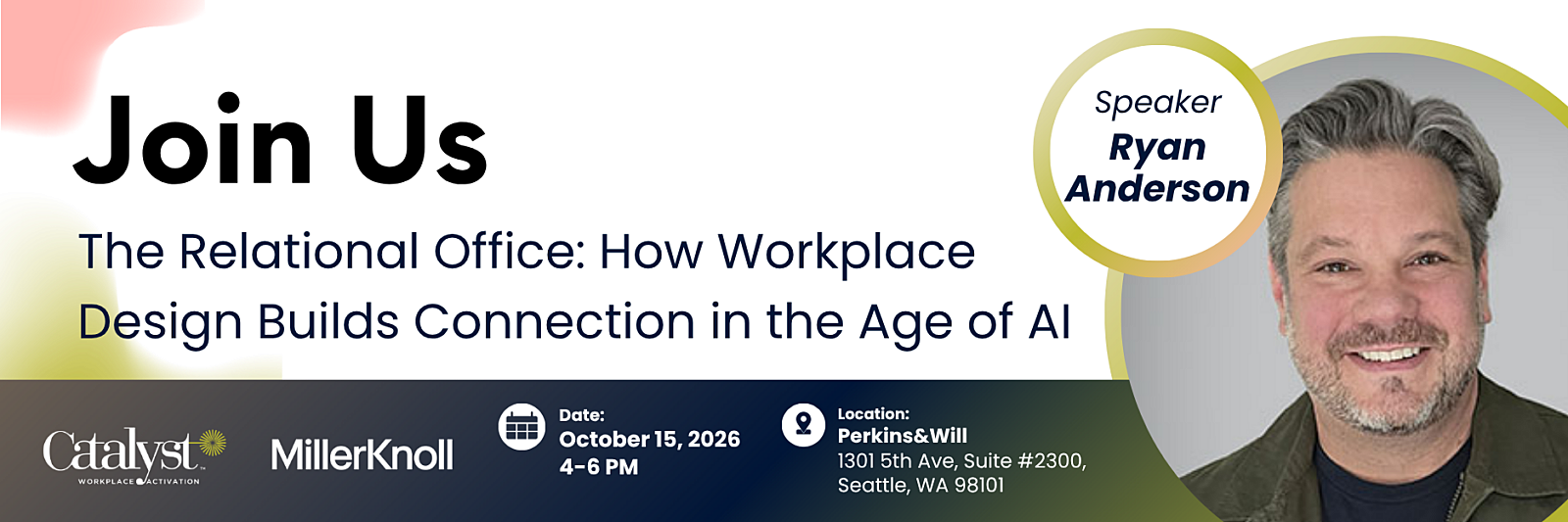
We're teaming up with MillerKnoll to co-sponsor an upcoming CoreNet Seattle program, "The Relational Office: How Workplace Design Builds Connection in the Age of AI." The session features Ryan Anderson, whose perspective on the future of work draws audiences across the commercial interiors industry.
Event Details
Date: October 15, 2026, 4:00-6:00 PM
Location: Perkins and Will, Downtown Seattle
1301 5th Ave, Suite #2300, Seattle, WA 98101
Overview
In an era of AI-enabled work, organizations face a new challenge: ensuring that technology enhances rather than diminishes the relationships that drive collaboration, innovation, and culture. Employees have more ways than ever to connect digitally, with one another and increasingly with AI agents, yet many struggle to build the trust-based relationships that underpin high-performing teams. As these human ties fray, organizations risk not only greater isolation and burnout, but also weaker collaboration, creativity, and innovation.
In this context, physical workplaces can offer more value than they have in decades. Rather than serving primarily as a place to complete tasks, a relationship-based approach to planning can help organizations turn their workplaces into incubators for talent development, idea generation, relationship-building, and creative problem-solving.
This session explores the shift from activity-based workplace planning toward a relationship-based approach: moving from the question "What activities should this space support?" to "What interactions should this space enable?" Participants will examine how workplace environments can strengthen team dynamics, support mentorship, cultivate belonging, and foster cross-functional connection in an AI-enabled future.
What attendees will take away
By the end of the session, attendees will be able to:
- Understand how AI is reshaping work and why uniquely human capacities such as trust-building, collaboration, creativity, and mentorship have become increasingly valuable as technology augments routine work.
- Distinguish between activity-based and relationship-based workplace planning, and understand how focusing on interactions can extend traditional workplace strategy.
- Recognize the workplace interactions that most influence organizational performance, including mentorship, team cohesion, cross-functional collaboration, belonging, and knowledge sharing.
- Identify opportunities to apply a Relationship-Based Work lens to workplace strategy, creating environments that support connection, learning, growth, and innovation in an AI-enabled era.